


If you love the daily satisfaction of Wordle but crave a puzzle you can play endlessly, your answer is Mastermind. It’s a classic code-breaking game that swaps vocabulary for pure, satisfying logic. Forget knowing obscure words; success here is all about smart deduction and that thrilling “Aha!” moment when the solution clicks into place. Check out bielsko wapienica to know more
At its heart, the goal is simple: the computer hides a secret code of colored pegs, and you have a limited number of turns to guess it. After each guess, the game gives you feedback, turning each round into an intense conversation between you and the codemaker. Understanding these clues is the key to cracking your first code in minutes and making your initial guesses count.
What’s the Point? Your Mission in the Code Breaker Game
The Mastermind puzzle is a straightforward challenge with a single, clear mission. The computer takes on the role of the “Codemaker” by creating a secret sequence of colored pegs. Your job, as the player, is to put on your detective hat and figure out that exact hidden code.
This makes you the official Codebreaker. In this beginner-friendly game, you aren’t just guessing randomly. You will make a series of attempts, and with each one, the game provides crucial feedback that helps you deduce the correct answer. Each guess should be smarter than the last, bringing you one step closer to the solution.
To claim victory, you must guess the secret code—both the right colors and their exact positions—before you run out of turns. Most online versions give you about ten attempts to solve the puzzle, adding a fun layer of pressure. Guess correctly in time, and you’ve won! To become a master Codebreaker, you first need to understand your tools.
Decoding the Digital Board: From Code Pegs to Clue Pegs
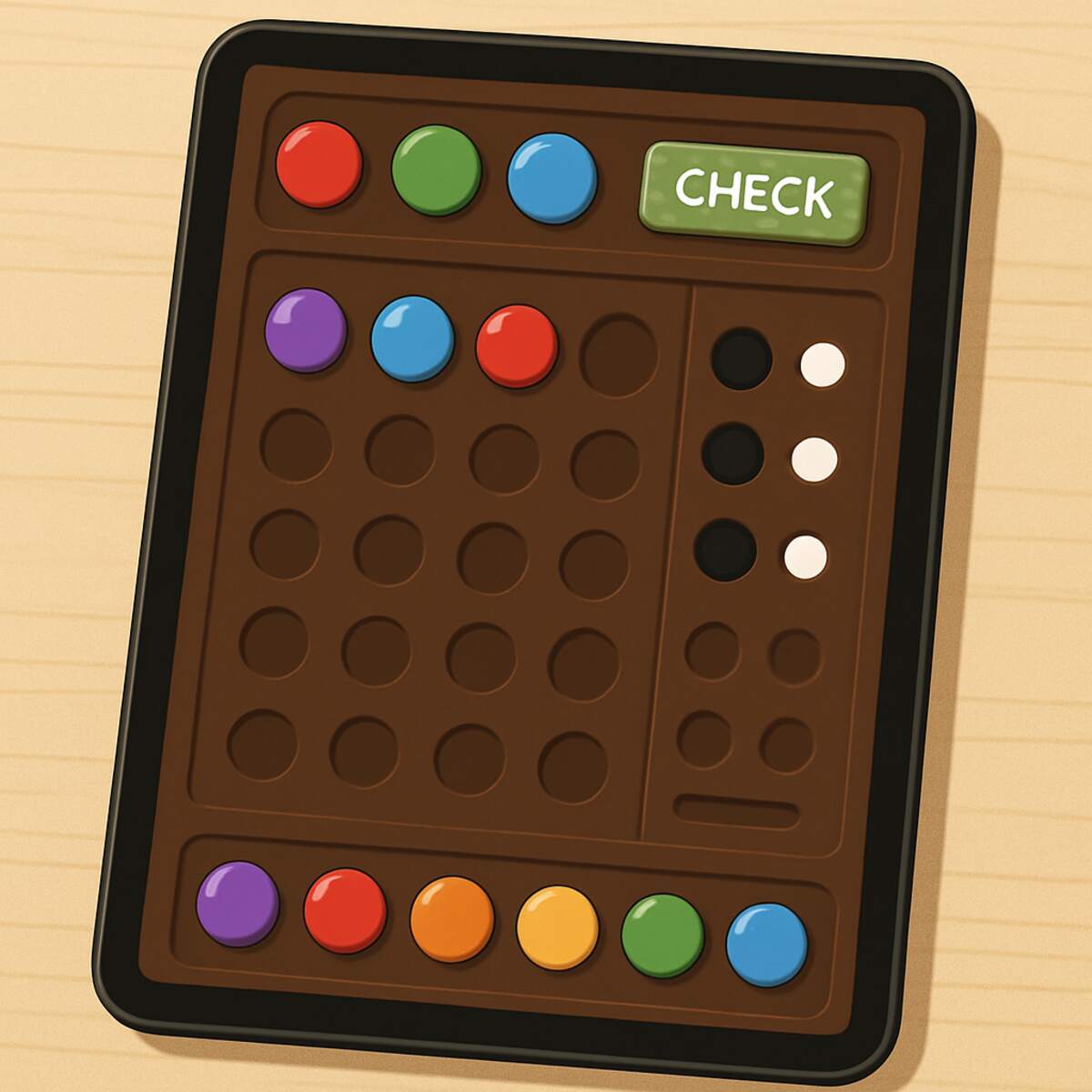
When you first load up an online version of Mastermind, you’ll see a large game board, a palette of bright colors, and a series of empty rows. It might look a little complex, but it’s organized into three simple zones that you’ll use on every single turn.
A typical digital Mastermind game board is split into these key sections:
- The Guessing Rows: This is the main play area. Each row has several empty slots where you will place your code peg color combination guess for that turn.
- The Color Palette: Usually off to one side or at the bottom, this is your supply of colored pegs. You’ll click or drag these colors into the guessing rows.
- The Feedback Area: Right next to each guessing row, you’ll find a small block of empty holes. This is where the game will give you small clue pegs after each guess.
Think of it as a simple loop: you use the Color Palette to build a guess in the current Guessing Row, and then you look to the Feedback Area for your clues. Those tiny black and white pegs are the most important part of the game, as they hold all the information you need to solve the puzzle.
Cracking the Code: What the Black and White Pegs Mean
Those tiny feedback pegs are the entire secret to winning this code breaker game. After every guess you make, the computer will give you clues that tell you how close you are to the solution. Understanding what they mean is the difference between guessing randomly and thinking like a true detective.
The rules for these clues are simple but powerful. Here’s how mastermind scoring works on a fundamental level:
- A Black Peg means: You have the right color in the exact right spot. A perfect match!
- A White Peg means: You have a right color, but it’s in the wrong spot. Good color, bad placement.
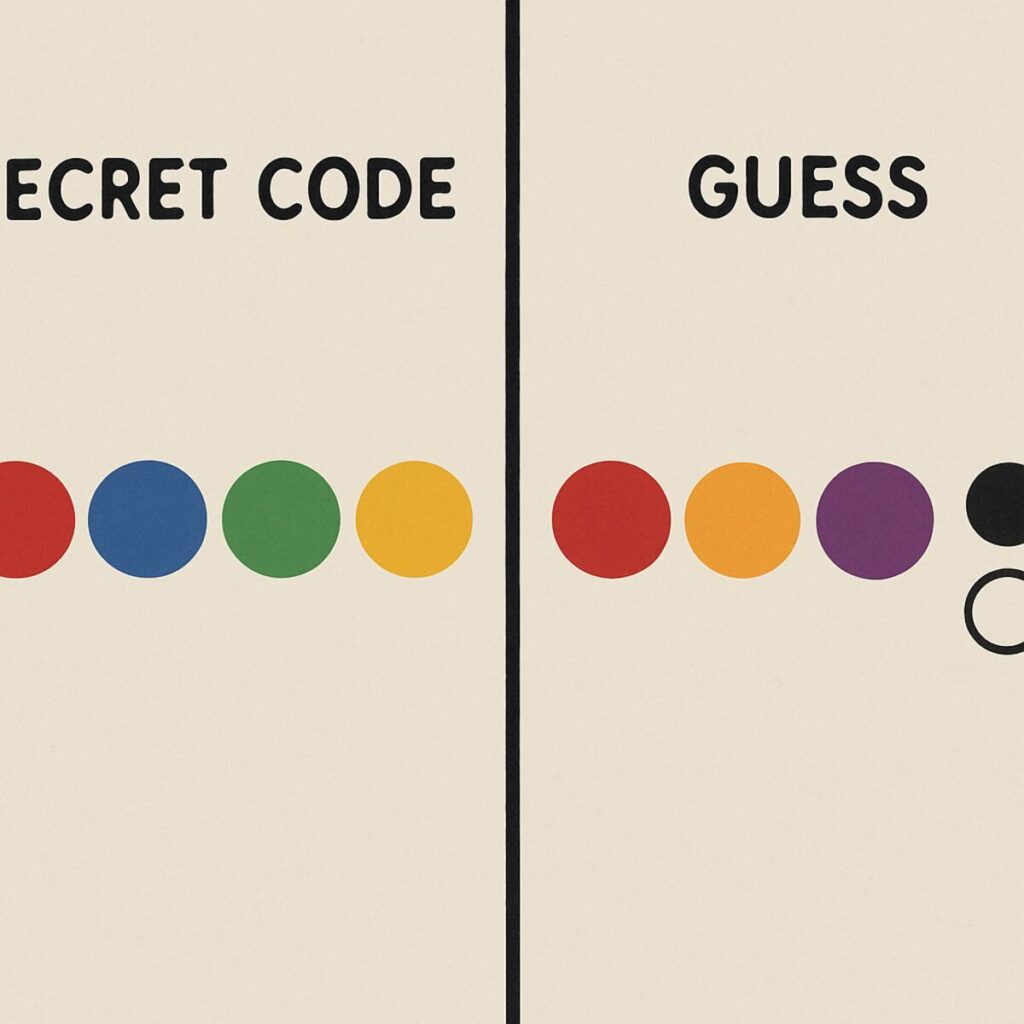
For example, imagine the hidden code is [Red, Blue, Green, Yellow]. If you were to guess [Red, Yellow, Orange, Purple], you would receive one black peg and one white peg as feedback. You get a black peg because your Red is a perfect match. You get a white peg because Yellow is in the code, but your guess has it in the wrong position. The Orange and Purple get no feedback because they aren’t in the code at all.
One crucial detail is that the position of the feedback pegs doesn’t correspond to your guess. The game only tells you the total count—one black and one white—not which of your colored pegs they apply to. This is a core part of the challenge and a key to mastermind puzzle solving techniques.
Putting the Clues to Work: From First Guess to Smart Second Move
Knowing what the pegs mean is one thing, but using them to crack the code is where the real fun of mastermind puzzle solving techniques begins. This is where you shift from a guesser to a detective. Your goal for every turn after the first is to make a guess that proves or disproves a theory, not just to throw more colors at the board. It’s the core of all deductive reasoning games online.
Imagine your first guess is [Red, Blue, Green, Yellow] and the feedback you get is one black peg and one white peg. You now know for certain that two of these colors are in the secret code and the other two are duds. Your job is to figure out which is which.
Based on that feedback, you can start forming a hypothesis. Let’s theorize that the Red peg is your perfect match (the black peg). This means it’s the right color in the right spot. That would also imply that one of the other colors—Blue, Green, or Yellow—is the right color in the wrong spot (the white peg). You can also logically conclude that two of those colors are completely wrong and can be discarded.
Now, you can create a second guess that tests this theory. If you believe Red is correct in the first position, keep it there. Then, rearrange the other potential colors and introduce new ones to gather more information. A smart second guess might be [Red, Orange, Blue, Purple]. This keeps Red in place, tests Blue in a new spot, and replaces the colors you suspect are wrong (Green and Yellow) with new ones. This methodical approach is the heart of any good guide to the code breaker game, turning pure luck into skillful deduction.
Your Best First Move: Casting a Wide Net
So, what’s the secret to getting the best possible clues on your very first turn? One of the simplest yet most effective mastermind game winning strategies is to start with four different colors. A guess like [Red, Blue, Green, Yellow] is powerful because it tests a wide range of possibilities at once, giving you the maximum amount of information to work with, no matter what feedback you get. Think of it as casting a wide net to see what you can catch.
You might think that getting zero feedback pegs is a total failure, but it’s actually fantastic news. If your four-color guess yields no black or white pegs, you’ve just learned with 100% certainty that none of those four colors are in the secret code. This is a huge leap forward, as you’ve instantly eliminated a huge chunk of possibilities without any complicated deduction.
For this reason, you should avoid using duplicate colors, like [Red, Red, Blue, Green], on your opening move. While duplicates are a key part of more advanced mastermind puzzle solving techniques, using them on turn one just reduces the amount of new information you can gather. You’re essentially “wasting” a slot that could have been used to test another color. Start wide, then narrow your focus once you have your first set of clues.
A Pro Move: Using Duplicates to Your Advantage
While casting a wide net with four different colors is a fantastic starting point, what happens when you want to level up your game? The trickiest codes to crack are often the ones with duplicate colors, but you can use a clever opening to hunt for them immediately. This approach flips the previous advice on its head and gives you a powerful new tool.
For a more aggressive opening, many players use a pattern with duplicates on the very first turn. This is a core part of the famous mastermind five guess strategy, which is designed to solve the puzzle with incredible efficiency. Instead of testing four colors, you test two colors in two positions each.
One of the best mastermind game winning strategies follows this simple, three-step process:
- First Guess: Always start with a pattern of two pairs, like [Red] [Red] [Blue] [Blue].
- Analyze Feedback: This first guess tells you a surprising amount about duplicates. For example, getting one black peg and one white peg is a huge clue: it tells you the code contains exactly one Red and one Blue.
- Systematically Eliminate: Use your next guesses to confirm the positions of your known colors (the Red and Blue) while testing new colors in the remaining empty slots.
This approach shines because it confronts the hardest part of the puzzle—duplicate colors—head-on. By confirming or eliminating duplicates on your very first move, you make your follow-up deductions much simpler. It’s a classic example of advanced mastermind puzzle solving techniques that is surprisingly easy to use once you try it.
How Does Mastermind Scoring Work?
After you’ve cracked a tough code, you might wonder how your performance is measured. Your score in Mastermind is simply the number of guesses it took you to solve the puzzle. That’s it! The fewer rows you fill on your way to the solution, the better your score.
The real goal, then, is to be as efficient as possible with your logic. Solving the code in six guesses is a great achievement, but solving it in five is even better. This simple metric makes the mastermind game online incredibly replayable, as you’re always competing against your own best performance.
While the number of guesses is the classic measure, some online versions add a timer for an extra layer of challenge. When you play a two player online mastermind game, you might be competing to see who can solve the same code faster or in fewer attempts. Ultimately, the ‘win’ is that satisfying ‘Aha!’ moment when the puzzle finally clicks into place.
Ready to Play? The 3 Best Places to Play Mastermind Online Now
You’re probably eager to play the mastermind board game online. The good news is, you don’t need to buy a physical copy. Plenty of excellent, free versions are just a click away. Finding the best digital mastermind game for you is easy, as each offers a slightly different experience.
Here are three fantastic and free places to start cracking codes immediately:
- MathsIsFun.com: This is the perfect starting point. The interface is incredibly clean, simple, and has zero distracting ads. It’s an ideal, no-frills environment to learn the rules.
- Archimedes-Lab.org: If you want a more classic feel that looks like the original board, this is your spot. It also lets you customize the game by changing the number of colors or code pegs, giving you more control over the difficulty.
- Puzzle-Mastermind.com: For those who love a modern, polished look, this site delivers. Its sleek, app-like design works beautifully on both desktop and mobile, making it a great choice for a quick game anywhere.
Pick one that sounds right for you and see how few guesses it takes to crack your first code. As you get the hang of it, you might find yourself hooked on this daily dose of logic.
Mastermind vs. Wordle: Which Daily Puzzle Will Be Your New Favorite?
That “guess-and-check” feeling you get from Mastermind might feel instantly familiar, especially if you’re one of the millions who play Wordle. Both games give you that satisfying “aha!” moment when you use clues to narrow down the possibilities. But while they share a similar core loop, the kind of thinking you use for each is surprisingly different.
In Wordle, you’re constantly tapping into your knowledge of language. You know which letters are common, how vowels are usually distributed, and what letter combinations form real words. Your brain acts like a linguistic detective, filtering the puzzle through your internal dictionary.
Mastermind, however, is a game of pure, abstract logic. The colors are just symbols; Red has no more relationship to Blue than a square has to a circle. This is what makes it one of the classic deductive reasoning games online. You aren’t relying on any outside knowledge, only the cold, hard feedback from your previous guesses. When you play logic puzzles like mastermind, you’re training your brain to see patterns and eliminate possibilities in a completely systematic way.
So, in the matchup of Mastermind vs. Wordle, the winner is a matter of mood. Wordle is a shared daily ritual rooted in language, while Mastermind is a personal logic challenge you can play endlessly.
Rule Variations: How Duplicates Change the Game
Just when you think you have a handle on the game, many online versions of Mastermind throw in a major curveball: duplicate colors. This common rule variation means the secret code, instead of being four unique colors, could be something like Red-Blue-Red-Yellow. It’s a small change that completely alters the puzzle, turning this classic code peg color combination game into a much deeper challenge.
Suddenly, your reliable first guess of using four different colors isn’t as powerful. Imagine the secret code is Blue-Blue-Green-Green. Your opening guess of Red-Orange-Yellow-Purple would get you zero feedback pegs. While you’ve successfully eliminated four colors from the board, you’ve learned nothing about the potential for duplicates.
One of the most effective mastermind puzzle solving techniques for duplicate-allowed games is to start with a paired guess, like Red-Red-Blue-Blue. This move is powerful because it immediately tests the duplicate theory. The feedback you get tells you not just about which colors are present, but about the structure of the code itself. Mastering these adjustments is what separates a good guesser from a true code-cracker.
Love Mastermind? Try These 3 Deductive Reasoning Games Next
The thrill of cracking the code in Mastermind comes from that satisfying “Aha!” moment when logic leads you to the one correct answer. If you’re looking for great mastermind game alternatives online that scratch the same intellectual itch, the world of deductive reasoning games online is vast. The skills you’ve sharpened by playing Mastermind will give you a running start.
Here are a few logic puzzles that capture a similar spirit, perfect for when you want to play logic puzzles like mastermind:
- Nonograms (Picross): Imagine a paint-by-numbers puzzle where you have to deduce which squares to fill. Using number clues for each row and column, you’ll slowly reveal a hidden pixel-art picture.
- Kakuro: Often described as a mathematical crossword, Kakuro challenges you to fill a grid with digits so they add up to a specific sum, with the added rule that no digit can be repeated in a single entry.
- Sudoku: A classic for a reason. Just like Mastermind, it’s a game of pure process of elimination, but with numbers on a grid instead of colors in a row.
You’re Ready to Be a Codebreaker
What may have seemed like a confusing puzzle of random colors is now a fun, solvable challenge. You’re now equipped with the knowledge to turn a simple guess into a calculated move.
This isn’t a game of luck; it’s a satisfying loop where you guess, analyze the clues, and deduce a smarter move. With each round, you’ll feel your skills sharpen as you put these mastermind puzzle solving techniques into action, turning each piece of feedback into a breakthrough.
That rewarding “Aha!” moment—when the logic clicks and the secret code finally reveals itself—is just a few guesses away. So go find a game, place your first row of colors, and begin your investigation. It’s time to crack your first code.
