


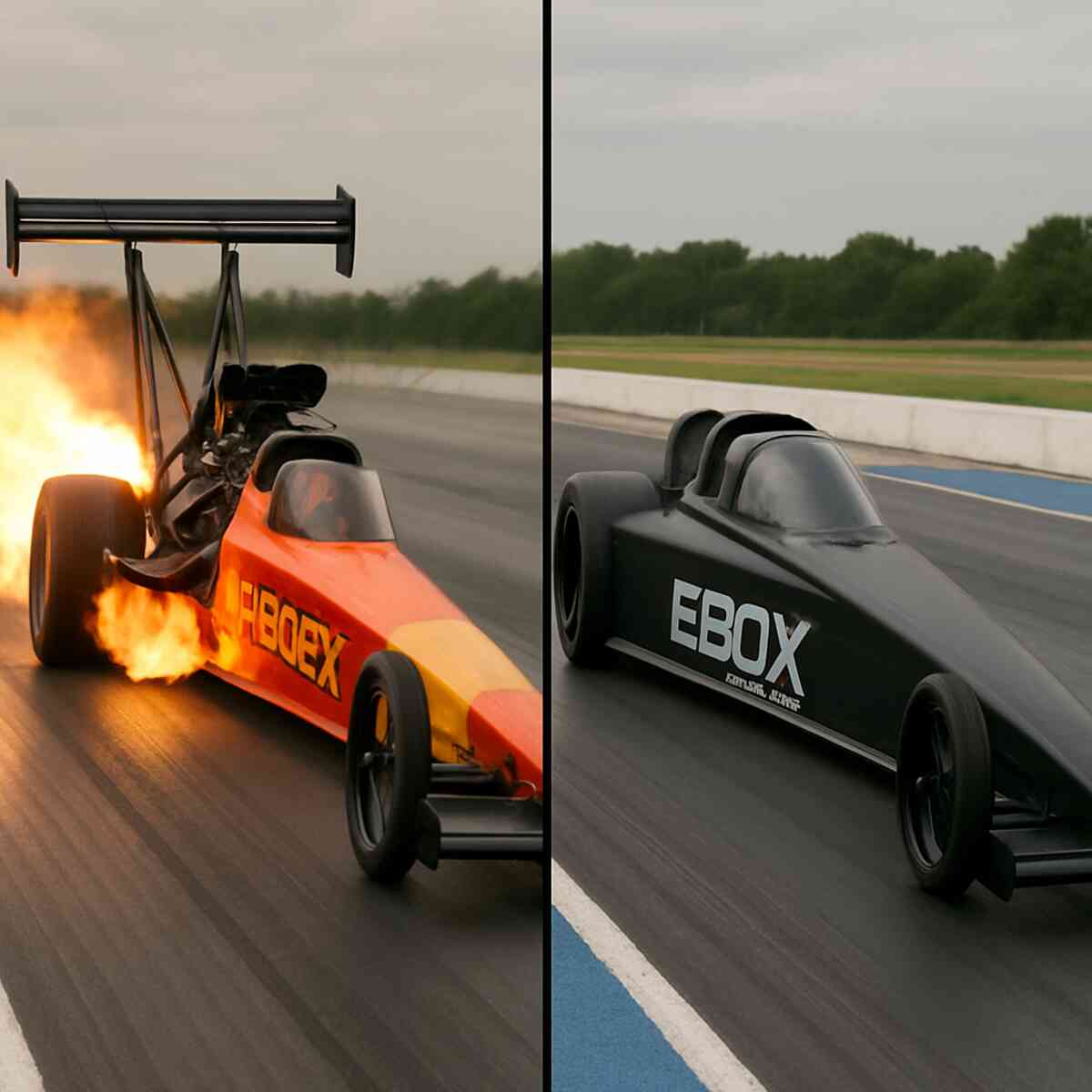
Picture a drag race. You probably hear a ground-shaking roar that rattles your bones, right? Now, imagine a car that launches even faster, but the only sounds are a high-tech whine and the shriek of tires. This is the strange and powerful world of the Ebox Dragster, a new breed of racer that trades explosions for electrons. Have the Best information about E box dragster.
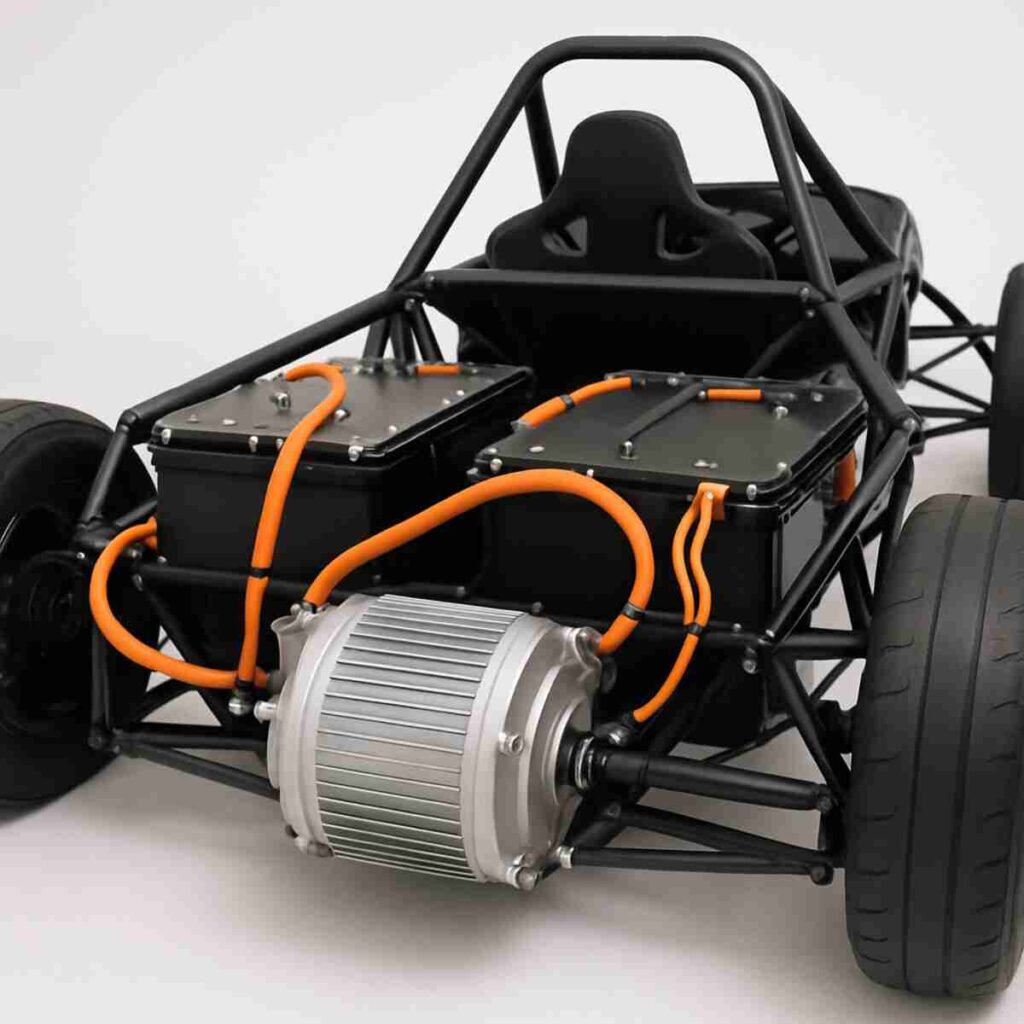
So what separates these silent contenders from traditional dragsters? It’s surprisingly simple. Instead of a complex, fuel-guzzling engine and a gas tank, an Ebox Dragster runs on a massive battery pack—like thousands of smartphone batteries linked together—and a powerful electric motor. This core swap is the key to everything that makes them different.
The real secret to their incredible speed isn’t just about being electric; it’s about being instant. A gas engine needs a moment to rev up and build to its full power. An electric motor, however, works like a light switch. The instant the driver hits the pedal, it delivers 100% of its twisting force. In practice, this means there is zero lag between the “go” signal and explosive forward motion.
This fundamental difference is rewriting the rules of electric drag racing, explaining both the shocking quietness and the physics-defying launch. How these components work together reveals not just a new type of race car, but a fascinating glimpse into the future of raw, unadulterated speed.
The ‘Muscles’: How a Racing Battery Dwarfs Your Phone’s Power
While the battery in your phone is designed to sip power all day, the battery pack in an Ebox dragster is built for one thing: overwhelming force. Forget the small slab you’re used to; picture a custom-built chest packed with high-tech cells, containing hundreds of times the energy of a laptop battery. This isn’t just a fuel tank holding energy for later. In the world of high-performance electric race cars, this battery pack is the source of the car’s raw, explosive muscle.
The real secret isn’t just how much energy is stored, but how fast it can be released. Engineers call this the energy discharge rate. Think of it this way: a regular EV’s battery is like a garden hose, designed to deliver water steadily for a long time to maximize range. A racing battery, however, is a fire hose. Its entire job is to dump its massive energy supply in one breathtaking, violent torrent that lasts just a few seconds.
This incredible battery technology for EV racing provides all the potential power the car needs to shatter records. But having a fire hose of electricity is useless—and incredibly dangerous—without a way to control it. All that raw power from the ‘muscles’ needs a command center to tell it exactly when and how to unleash its fury.
The ‘Brain’: The Smart Switch That Unleashes 2,000+ Horsepower
If the battery pack is the car’s brute-force muscle, then the controller (or inverter) is its lightning-fast brain. This component acts as the ultimate gatekeeper, standing between the battery’s overwhelming surge of electricity and the motor. Without it, unleashing the battery’s full power would be like opening a dam all at once—a chaotic and useless explosion of energy. The controller’s job is to take that raw power and shape it into a perfectly controlled, intelligent command.
Think of this system like a sophisticated dimmer switch for a lightbulb. A simple on/off switch gives you either nothing or everything. But a dimmer allows you to smoothly ramp up the brightness to the exact level you want. The dragster’s controller is that dimmer switch on an epic scale, making thousands of adjustments every second. It precisely dictates how much power flows from the battery to the motor, giving the driver incredible finesse over the car’s launch and acceleration. This is a key part of how electric dragsters work so effectively.
On the drag strip, this split-second control is everything. Dump too much power at once, and the tires will instantly break loose, spinning in place and creating a massive cloud of smoke but going nowhere fast. This is the challenge of improving EV dragster launch control. The controller ensures the motor receives the maximum possible power without overpowering the tires, turning raw electrical force into record-shattering grip. Now that this ‘brain’ has sent its orders, that power needs to be turned into pure forward motion.
The ‘Legs’: Why an Electric Motor is a Master of Simplicity and Speed
All that perfectly controlled electricity from the car’s “brain” has to go somewhere to create motion. It flows into the electric motor, the vehicle’s powerful legs. A motor has one of the simplest jobs imaginable: when it receives electricity, it spins. Think of a household fan—you give it power, and a small motor inside turns the blades. An electric dragster’s motor operates on that same principle, just scaled up to produce an incredible amount of force. It’s a master of converting electrical commands into pure, raw rotation.
What’s revolutionary about this high-performance electric race car is what’s missing. A gasoline engine is a mechanical symphony of hundreds of moving parts: pistons pumping, valves snapping open and shut, and controlled explosions happening thousands of times a minute. By contrast, a high-performance electric motor is beautifully simple, typically having only one major moving part. This minimalist electric dragster motor design means there’s less to break and, more importantly, no delay. The moment power arrives, it spins.
This immediate, powerful rotation is transferred to the wheels with almost no interruption. Unlike a gas car with a complex transmission, the motor’s spinning shaft is connected very directly to the axle. This creates a near-perfect, one-to-one relationship between the controller’s electrical signal and the car’s forward thrust. However, it’s how this motor delivers its spinning force from a dead stop that contains the real secret to its dominance on the drag strip.
The Secret Weapon: What Is “Instant Torque” and Why Does It Win Races?
That secret lies in a concept that’s easier to feel than to explain. Think about trying to open a stubborn jar lid. You don’t use a slow, gentle turn; you need a sharp, powerful twist, right from the start, to break it free. That initial twisting force is what engineers call torque. In racing, having the most torque at the very beginning is a game-changer.
An electric motor is the undisputed champion of this. It delivers its full twisting force the instant the controller sends power—no differently than a light switch provides light the moment you flip it. There is no ramp-up, no waiting. This incredible ability to apply 100% of its power from a dead stop is the Ebox Dragster’s ultimate weapon: instant torque.
For all its thunderous noise, a traditional gasoline engine simply can’t compete here. It has to “rev up” to build power, like a sprinter taking a deep breath before dashing forward. The engine needs to spin faster and faster to reach its peak torque. That tiny delay, just a fraction of a second while pistons start pumping, and parts get moving, is a massive opening for an electric opponent.
In a drag race, where the first 60 feet often decide the winner, this difference is everything. The Ebox Dragster’s instant torque advantage allows it to explode off the starting line, gaining an undeniable lead while the gas-powered car is still building momentum. This incredible head start is how a nearly silent machine can leave a roaring champion in its dust.
The Silent Record-Breaker: Just How Fast Is an Ebox Dragster?
All that talk about instant torque sounds impressive, but what does it actually deliver on the racetrack? The results are almost hard to believe. In drag racing, performance is measured by two key numbers: the 0-60 mph time, which shows pure off-the-line acceleration, and the quarter-mile time, the total time it takes to cover the 1,320-foot track. One of the fastest electric drag cars, built by Steve Huff Motorsports, rocketed into the record books by hitting over 200 mph in the quarter-mile. But the truly staggering figure is its acceleration: it goes from 0 to 60 mph in less than one second.
To put that into perspective, let’s compare the silent electric warrior to the loudest, most powerful car on the planet: the 11,000-horsepower Top Fuel dragster. While the Top Fuel car is the undisputed king of overall speed, the numbers at the start of the race tell a fascinating story.
- 0-60 MPH: Ebox Dragster (~0.9 seconds) vs. Top Fuel (~0.8 seconds)
- Quarter-Mile Speed: Ebox Dragster (~201 mph) vs. Top Fuel (~330+ mph)
- Sound Level: Ebox Dragster (A high-tech whir) vs. Top Fuel (Loud enough to shake buildings)
The Ebox Dragster is right on the heels of the Top Fuel car for initial acceleration, a stunning achievement for a machine with a fraction of the power. While the gas-guzzling monster eventually pulls away to a much higher top speed, the electric car proves it can win the all-important battle at the starting line. This sets up a classic rivalry: the explosive, instant punch of electricity against the overwhelming, building fury of nitro-methane.
Sound, Speed, and Simplicity: The Head-to-Head Battle with Nitro
The battle between electric and nitro isn’t just about the stopwatch; it’s a total clash of experiences. A traditional nitro-burning Top Fuel dragster is a violent assault on the senses—a ground-shaking explosion of sound and the sharp smell of burning fuel that hits you in the chest. By contrast, watching an Ebox dragster launch is an eerie, almost sci-fi event. There’s the screech of tortured tires and a high-frequency whir, like something out of a movie, as the car simply vanishes from the starting line in near silence.
This difference in sensation mirrors how each car generates its speed. The electric dragster is a pure sprinter, unleashing nearly all its power in one massive, instant shove. This is why it’s so dominant in the first few feet of the race. The nitro car, however, is a different beast. It’s a brawler that builds power continuously. While the electric car is winning the launch, the nitro engine is just getting started, creating a tidal wave of force that keeps pushing harder and harder all the way down the track, resulting in a much higher top-end speed.
Perhaps the biggest difference reveals itself after the race is over. The crew for a nitro car swarms it, immediately beginning the frantic process of tearing down and rebuilding major parts of the engine, which is pushed to the brink of self-destruction on every run. For the Ebox team, the post-race routine is comparatively calm. They analyze data from a laptop and, most importantly, plug the car in to recharge, much like a smartphone after a busy day.
Given that electric power is simpler and so effective at the start, it raises a natural question: why hasn’t it taken over completely? While the mechanics are less complex, harnessing and delivering that much electricity safely and effectively is an incredible engineering feat, presenting its own unique and expensive set of challenges.
The Guardian of the Juice: Why Batteries Need a Brain
While the electric motor gets all the glory for creating motion, it’s the battery pack that holds all the potential. But harnessing that much raw energy isn’t as simple as wiring a big battery to a big motor. Think about your smartphone—if it gets too hot while charging, it automatically slows down or stops to protect itself. Now, imagine that on a scale a hundred thousand times more powerful. An uncontrolled discharge from a dragster’s battery pack could be catastrophic.
This is where the unsung hero of the Ebox dragster comes in: the Battery Management System, or BMS. You can think of the BMS as the battery pack’s brain and nervous system all rolled into one. Its job is incredibly important and has two main functions. First, it acts as a security guard, constantly monitoring the temperature and power flow of thousands of individual battery cells to prevent them from overheating or discharging too quickly, which could lead to fire or failure.
Second, the BMS plays the role of a meticulous coach, ensuring every single cell in the pack is working in perfect harmony. It makes sure they all charge and discharge evenly, maximizing both the car’s performance on a given run and the overall lifespan of the multi-thousand-dollar battery pack. Without this sophisticated electronic brain, the raw power stored in the batteries would be both unusable and incredibly dangerous, making the BMS the crucial component that turns a powerful battery into a safe and competitive weapon.
The Rules are Changing: Where Do Electric Dragsters Fit in the NHRA?
For any sport to be fair, it needs a rulebook. For professional drag racing in the United States, that rulebook is written by the National Hot Rod Association, or NHRA. For decades, the NHRA has created different classes based on things like engine size, fuel type, and car weight. But when stunningly fast electric cars began to appear, they didn’t fit into any of the old boxes. They had no fuel and no engine in the traditional sense, leaving officials with a big question: Where do these silent speed demons belong?
In a landmark move, the NHRA provided a clear answer by creating an entirely new competition category just for electric vehicles. This wasn’t just a small update; it was the official recognition of electric power as a legitimate force in the sport. By establishing the NHRA electric vehicle class rules, the organization gave these pioneering cars a formal home to compete, set records, and crown champions. This decision signaled to the entire racing world that electric drag racing is not a novelty—it’s the real deal.
This shift ensures the future of electric drag racing is integrated directly into the sport’s highest level. The goal isn’t to replace the thunder of V8S but to add the high-tech whir of electric motors to the symphony of speed. Imagine a day at the track where fans can appreciate the raw power of a traditional Top Fuel car one minute and the shocking, silent launch of an Ebox dragster the next. The NHRA has officially opened the door for a new era of competition, where different technologies battle for the same ultimate prize: being the first to the finish line.
What’s Next?: The Inevitable Rise of the Silent Supercar
Before reading this, you might have thought the fastest cars had to be the loudest—that speed was announced with a ground-shaking roar. Now you know the opposite can be true. You understand that the most violent launch off the line can happen in an eerie quiet, and you know the simple secret behind the Ebox dragster’s power.
It isn’t magic, but a lesson in focus. Instead of a gas engine’s complex explosion, the electric system works like a single muscle. The batteries, brain, and motor act as one, unleashing all their power in the same instant the light turns green. This is the heart of instant torque—not building up to speed, but starting with it.
You’re now equipped to see this principle everywhere. The next time you watch a Tesla silently leap ahead at a stoplight, you’ll know you’re seeing a tiny echo of an Ebox dragster’s launch. You can confidently explain to a friend why that instant, quiet jump is the key advantage an electric vs nitro dragster holds.
The thundering roar of a V8 will forever be a part of racing’s soul, a sound tied to history and tradition. But the high-pitched whine of a motor spinning at 20,000 RPM is more than just a new noise. It’s the Tradition sound of the rules changing—and the undeniable sound of the future of electric drag racing.
